Data-Led Hiring: Insights That Actually Influence Decisions
Discover how data-led hiring helps organisations make smarter recruitment decisions, improve hiring efficiency, reduce bias, and build stronger workforces through actionable recruitment insights.
intalent.ai
November 1, 2026
Table of Content
Introduction
What Is Data-Led Hiring?
Why Data-Led Hiring Matters for Modern Organisations
The Recruitment Metrics That Actually Influence Decisions
The Role of AI and Recruitment Intelligence
Share
Introduction
Hiring has always involved a degree of judgement. Recruiters assess experience, hiring managers evaluate capabilities, and leadership teams make decisions based on business priorities. But as recruitment becomes more complex, relying solely on intuition and historical practices is no longer enough.
Organisations today manage multiple job openings, hundreds of applications, diverse talent pools, and increasingly demanding hiring timelines. Without the right insights, even experienced recruitment teams can struggle to identify bottlenecks, evaluate performance, and understand what is actually driving successful hires.
This is where data-led hiring makes a difference.
Data-led hiring is the practice of using recruitment data, performance metrics, and actionable insights to guide talent acquisition decisions. Instead of simply tracking how many candidates enter the recruitment pipeline, organisations analyse what happens at every stage, why certain outcomes occur, and where improvements can be made.
The objective is not to replace human judgement with numbers. It is to give recruiters and decision-makers the information they need to make more informed, consistent, and effective hiring decisions.
What Is Data-Led Hiring?
Data-led hiring is an approach to recruitment that uses measurable information and analytics to improve how organisations attract, assess, select, and hire talent.
It involves collecting and analysing information across the recruitment lifecycle, including:
Candidate sourcing and application volumes.
Resume screening and shortlisting rates.
Interview scheduling and completion rates.
Candidate drop-off at different recruitment stages.
Time-to-hire and cost-per-hire.
Offer acceptance and joining rates.
Source effectiveness and quality of hire.
However, collecting recruitment data is only the first step. Its real value comes from interpreting the information and translating it into decisions.
For example, knowing that a company takes 45 days to fill a position is useful. Understanding that most of those 45 days are spent waiting for interview feedback is far more valuable. The first is a metric; the second identifies an opportunity for improvement.
That distinction separates basic recruitment reporting from meaningful recruitment intelligence.
Why Data-Led Hiring Matters for Modern Organisations
Recruitment decisions influence business productivity, workforce costs, employee performance, and long-term growth. Yet many organisations continue to make hiring decisions without a complete understanding of their recruitment performance.
A data-led approach helps address this challenge in several ways.
1. Identifying Recruitment Bottlenecks
A recruitment process involves several interconnected stages. Delays in screening, interview coordination, feedback collection, or offer approvals can affect the entire hiring timeline.
Recruitment analytics help identify exactly where candidates are getting stuck.
For instance, if a large percentage of candidates complete their initial screening but very few progress to interviews, the issue could lie in screening criteria, candidate quality, or alignment between recruiters and hiring managers.
Rather than assuming that the talent market is the problem, teams can investigate the actual cause and take corrective action.
2. Improving the Quality of Hiring Decisions
Hiring success should not be measured by how quickly a position is filled alone.
Organisations also need to understand whether candidates meet role requirements, perform well during assessments, accept offers, and contribute effectively after joining.
By evaluating relevant hiring outcomes alongside recruitment activity, companies can identify which sourcing channels, screening methods, and assessment approaches consistently deliver stronger candidates.
This creates a more structured foundation for future hiring decisions.
3. Making Better Use of Recruitment Budgets
Recruitment spending is often distributed across job portals, recruitment agencies, employee referrals, advertising campaigns, and internal talent acquisition teams.
But are these investments delivering the expected results?
Data can help organisations compare sourcing channels based on application quality, interview conversion, hiring outcomes, and associated costs.
For example, a job portal may generate a high volume of applications but produce very few shortlisted candidates. An employee referral programme may generate fewer applications but result in a higher percentage of successful hires.
Understanding these differences helps organisations allocate recruitment budgets more effectively.
4. Creating Greater Accountability Across Hiring Teams
Recruitment outcomes are rarely controlled by recruiters alone. Hiring managers, interviewers, department heads, and leadership teams all influence the process.
Data provides a shared view of recruitment performance.
Teams can evaluate interview turnaround times, feedback completion rates, approval delays, and hiring progress against agreed targets.
This encourages greater accountability and helps organisations address process-related challenges without relying on assumptions or individual opinions.
5. Supporting Workforce Planning
Historical recruitment data can reveal patterns in hiring demand, skill requirements, seasonal recruitment activity, and time-to-fill across different departments.
These insights can help HR leaders anticipate future talent requirements and prepare recruitment strategies before vacancies become urgent.
For growing organisations, this is particularly important. Workforce planning becomes more proactive when hiring decisions are supported by historical trends and business forecasts.
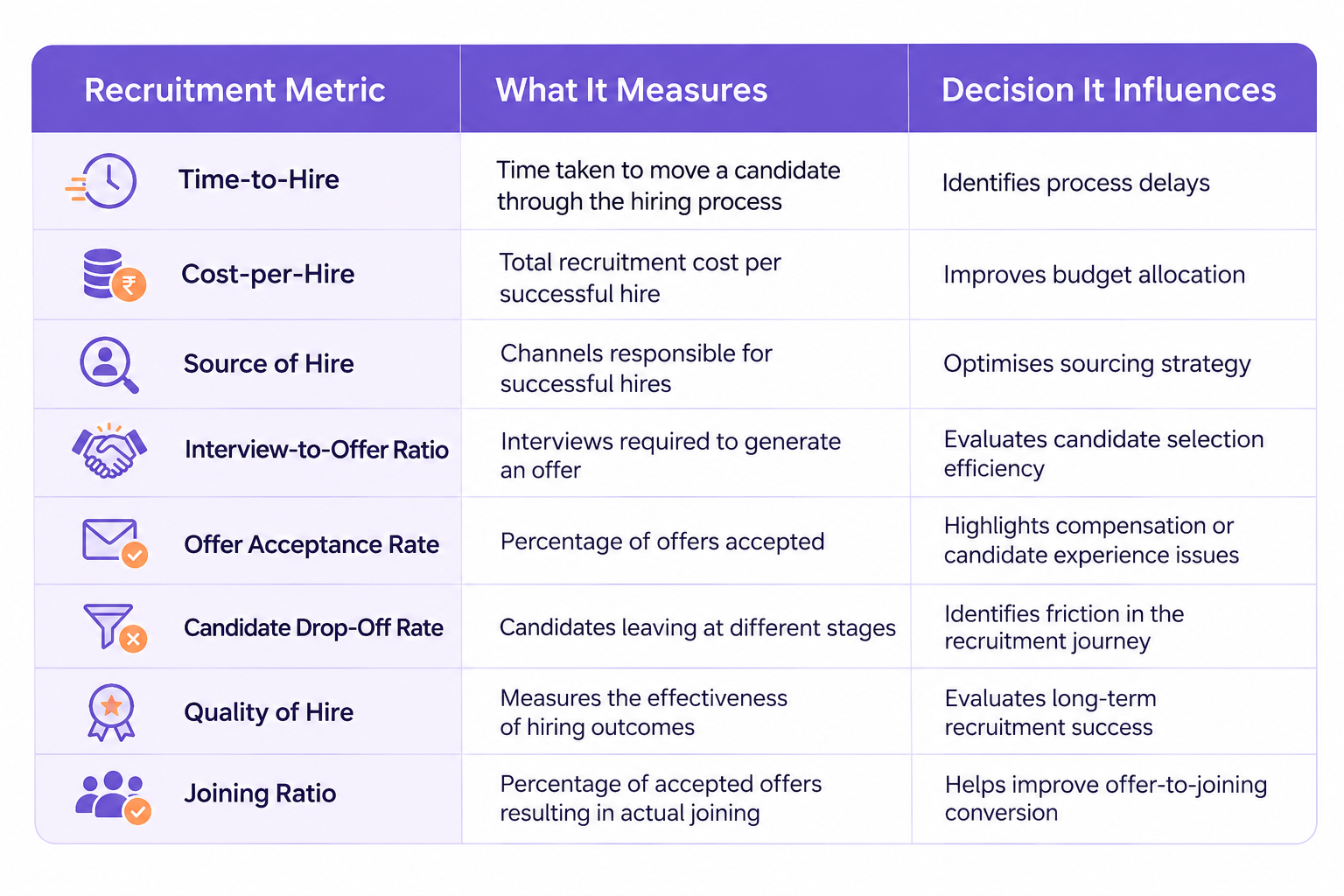
The Recruitment Metrics That Actually Influence Decisions
Not every recruitment metric deserves equal attention. Tracking dozens of numbers without understanding their business relevance can create more confusion than clarity.
The key is to focus on metrics that help answer important business questions.
Here are some of the most useful recruitment KPIs organisations should monitor.
The important consideration is to connect every metric to a specific question.
For example:
Is our time-to-hire increasing because of screening delays or interview scheduling?
Which sourcing channels consistently produce candidates who get hired?
Are candidates rejecting offers because of compensation expectations?
Which departments experience the longest recruitment cycles?
Where are we losing the most qualified candidates?
When metrics answer these questions, recruitment reporting becomes a decision-making tool rather than a collection of statistics.
From Recruitment Data to Actionable Insights: What Does the Process Look Like?
Having access to recruitment data does not automatically make an organisation data-driven. Teams need a structured approach to turn information into meaningful action.
A practical framework involves five stages.
Step 1: Collect Data Across the Recruitment Lifecycle
Start by consolidating information from different recruitment activities.
This includes candidate applications, sourcing channels, screening outcomes, interview feedback, offers, and joining status.
When information is scattered across spreadsheets, emails, and disconnected platforms, it becomes difficult to establish a complete picture of recruitment performance.
Centralised data makes analysis more consistent and reliable.
Step 2: Identify Patterns and Trends
Once the data is available, look for recurring patterns.
Compare recruitment performance across departments, job roles, locations, hiring managers, and sourcing channels.
For example, if engineering roles consistently take longer to fill than sales positions, investigate whether the difference is driven by skill availability, screening requirements, compensation, or interview complexity.
Patterns provide the starting point for better questions.
Step 3: Convert Metrics into Meaningful Insights
Raw numbers describe what happened. Insights explain why it happened and what could be done differently.
Consider a recruitment team that receives 1,000 applications but shortlists only 50 candidates.
The immediate observation is a 5% shortlisting rate.
The more important questions are:
Are job descriptions attracting the right applicants?
Are screening criteria too restrictive?
Are candidates missing essential qualifications?
Are sourcing channels aligned with the actual role requirements?
This deeper analysis helps identify the underlying issue instead of simply reporting the outcome.
Step 4: Take Action Based on the Findings
Insights should lead to measurable improvements.
If interview delays are the primary bottleneck, organisations might introduce structured scheduling processes and clearer feedback timelines.
If certain sourcing channels consistently underperform, recruitment budgets can be redirected towards more effective channels.
If offer acceptance rates are low, compensation benchmarks and candidate engagement strategies may need to be reviewed.
Every insight should ideally lead to an action, an owner, and a measurable outcome.
Step 5: Measure Whether the Decision Worked
Data-led hiring is an ongoing process.
After implementing a change, compare the new results against the original performance.
Did time-to-hire improve? Did candidate drop-off decrease? Did the quality of shortlisted candidates increase?
Measuring the impact of decisions helps organisations distinguish between changes that actually work and those that simply appear promising.
The Role of AI and Recruitment Intelligence
As recruitment volumes increase, manually analysing every stage of the hiring process becomes increasingly difficult.
Artificial intelligence and recruitment intelligence platforms are changing how organisations collect, interpret, and use hiring data.
Modern recruitment technology can help teams:
Automate repetitive screening and candidate evaluation tasks.
Analyse candidate information against job requirements.
Identify recruitment pipeline delays.
Generate reports on hiring performance.
Compare sourcing channels and candidate conversion rates.
Surface patterns across large volumes of recruitment data.
Provide faster access to relevant recruitment information.
The next evolution is moving beyond static dashboards towards intelligent systems that can help explain what is happening and surface insights that require attention.
For example, instead of manually reviewing multiple reports to understand why a position is taking longer to fill, a recruitment intelligence system could help identify that interview feedback delays or low candidate conversion rates are contributing to the problem.
Platforms such as intalent.ai are part of this evolving approach, bringing recruitment workflows, automation, and hiring insights into a more connected environment. The broader objective is to help recruitment teams spend less time managing repetitive activities and more time focusing on decisions that influence hiring outcomes.
However, AI-generated insights should always be interpreted with appropriate human oversight. Recruitment decisions involve people, and factors such as context, fairness, data quality, and individual circumstances must remain central.
Common Challenges in Implementing
Despite its advantages, adopting a data-led recruitment strategy comes with challenges.
1. Fragmented recruitment data: Information stored across multiple systems makes it difficult to build a consistent view of hiring performance.
2. Tracking too many metrics: Monitoring every available KPI can distract teams from the indicators that genuinely matter.
3. Inconsistent data quality: Incomplete candidate records, inconsistent status updates, and outdated information can lead to misleading conclusions.
4. Lack of actionable interpretation: Recruitment teams may have access to detailed dashboards but lack the time or expertise to translate reports into meaningful actions.
5. Over-reliance on historical data: Past hiring patterns should inform decisions, not automatically determine future ones. Historical data can contain existing biases and may not reflect changing talent markets.
6. Privacy and compliance concerns: Candidate information must be collected, stored, processed, and analysed responsibly, with appropriate access controls and compliance safeguards.
Overcoming these challenges requires a combination of reliable technology, clearly defined recruitment KPIs, consistent processes, and a culture that encourages evidence-based decision-making.
The Future of Hiring Is Not Just Data-Driven. It Is Decision-Driven.
The success of a recruitment function should not be determined by the number of applications processed, reports generated, or vacancies closed.
It should be measured by how effectively the organisation identifies talent, makes hiring decisions, uses its resources, and builds the workforce required for future growth.
Data-led hiring provides the foundation for this shift.
As AI, automation, and recruitment analytics continue to evolve, organisations will have greater opportunities to understand their hiring processes in real time, identify inefficiencies earlier, and make more informed workforce decisions.
But the real competitive advantage will not come from collecting more data. It will come from asking better questions, understanding what the numbers reveal, and acting on those insights.
Because better hiring decisions don't come from more reports. They come from insights that actually influence decisions.
Frequently Asked Questions (FAQs)
1. What is data-led hiring?
Data-led hiring is an approach to recruitment that uses measurable data, recruitment metrics, and analytics to guide hiring decisions. It helps organisations evaluate recruitment performance, identify inefficiencies, improve candidate selection, and make informed talent acquisition decisions.
2. What are the most important recruitment metrics to track?
Some of the most important recruitment metrics include time-to-hire, cost-per-hire, source of hire, quality of hire, offer acceptance rate, candidate drop-off rate, interview-to-offer ratio, and joining ratio. The right metrics depend on an organisation's hiring objectives and business priorities.
3. How does recruitment analytics improve hiring decisions?
Recruitment analytics helps identify patterns and inefficiencies across the hiring lifecycle. By analysing candidate conversion rates, sourcing performance, interview timelines, and hiring outcomes, organisations can make better decisions about recruitment strategies, budgets, and processes.
4. What is the difference between data-driven recruitment and traditional recruitment?
Traditional recruitment often relies heavily on experience, manual tracking, and subjective judgement. Data-driven recruitment combines professional judgement with measurable evidence, helping teams make more consistent decisions based on recruitment performance and outcomes.
5. How does AI support data-led hiring?
AI supports data-led hiring by automating repetitive recruitment activities, analysing candidate information, identifying patterns, and generating recruitment insights. It can help teams process information faster and identify areas that need attention while keeping human oversight in the decision-making process.
6. Can data-led hiring reduce recruitment costs?
Yes. By identifying effective sourcing channels, reducing unnecessary screening efforts, improving interview efficiency, and highlighting process bottlenecks, data-led hiring can help organisations use recruitment budgets and resources more effectively.
7. Is data-led hiring suitable for small and mid-sized businesses?
Yes. Small and mid-sized businesses can benefit from tracking a focused set of recruitment KPIs, such as time-to-hire, cost-per-hire, source of hire, and offer acceptance rate. Even basic recruitment analytics can help smaller teams make better hiring decisions without requiring complex reporting infrastructure.